The courses I taught
Teaching
Nearly twenty years in the classroom — from tutoring undergraduate mathematics, through academic courses in the Faculty of Exact Sciences, to workshops inside organisations and guest lectures abroad. The list is grouped by the kind of setting, and further down the page are the full syllabuses of the two courses I wrote.
In brief
What I taught
Courses & modules
Some of these I wrote from scratch — objectives, syllabus, materials and assignments; others are professional modules I built for training programmes and for the Projects Center.
Academic courses
Faculty of Exact Sciences, Holon Institute of Technology · 2016–2025
Geographic Information Systems (GIS)
HIT — Faculty of Exact Sciences
From first principles through to building geographic applications.
- GIS principles and data sources
- Standards in the field
- Spatial analysis
- Application development
Technological innovation
HIT — Faculty of Exact Sciences
High-tech trends, spotting opportunities, and the road from idea to product.
- Industry trends
- Identifying needs
- From idea to POC
Software development
HIT — Faculty of Exact Sciences
Development processes, tooling and the working methods industry actually uses.
Project management
HIT — Faculty of Exact Sciences
Planning, executing and controlling development projects in a multidisciplinary setting.
Courses I wrote from scratch
Full syllabus, materials and assignments — my own work
GIS applications
A course for users and operators
Builds a complete understanding of the systems that manage information whose location matters — alongside their limits and the ways round them. Weekly three-hour sessions, each pairing theory with hands-on work in open-source tools.
- What GIS is: principles and geographic data sources
- Trends and application domains for location-based information
- The open-source world — installation and setting up a working environment
- Interactive mapping, moving from 2D to 3D
- Big Data in a geographic context and multi-layer visualisation
- Finding and classifying open data sources
- Building databases and running multi-platform GIS projects
Introduction to machine learning and AI
A nine-module course
From motivation to ethics, with the emphasis on understanding the algorithms in practice.
- Introduction to machine learning
- Background and motivation
- Graphs and search algorithms
- Positive conditioning and reward prediction
- Introduction to data with ML
- Regression
- Decision trees
- Clustering
- Ethics in machine learning
Big Data
A six-module course
From framing the problem to running algorithms over a cloud analysis pipeline.
- Introduction to Big Data
- Structured and unstructured data
- The pipeline to analysis
- Big Data on the cloud
- Data loading techniques
- Techniques and algorithms
Further subjects I teach
Full courses I deliver in academia and inside organisations — a detailed syllabus is available to download
Technological Entrepreneurship
Semester course · 14 sessions
From a raw idea to a product with a paying customer. The emphasis is not on a handsome business plan but on testing the riskiest assumptions early and cheaply — who the customer is, what the pain is, and why now.
- Customer discovery
- Business models
- Defining an MVP
- Funding and intellectual property
- Pitching to investors
Sustainable Innovation
Semester course · 14 sessions
How to build a technological product that stands the economic, environmental and social test at once — not as a marketing gesture but as a design constraint that creates competitive advantage.
- Circular economy
- The footprint of technology
- Green computing
- ESG and measurement
- Regulation and spotting greenwashing
Information Systems Management
Semester course · 14 sessions
Most information systems failures are not technological but managerial: an incomplete specification, an unmanaged supplier, data nobody owns. The course gives the tools to run the whole estate.
- Architecture and core systems
- Procurement and tenders
- Data governance
- ITSM and SLAs
- IT budget and business continuity
Artificial Intelligence — the Organisational Dimension
Semester course · 14 sessions
Not how a model is built but where it produces real benefit and how that benefit is measured. The guiding principle is to apply, not simply to adopt: a tool enters the organisation only when a use case justifies it, with agreed success factors and metrics that can be tracked.
- Efficiency and organisational benefit
- Success factors and KPIs
- AI governance and risk
- Regulation and the EU AI Act
- Vibe coding
Professional modules
Lectures I built for the training programmes of the Projects Center and the PBLogic association
Introduction to project management
Training module
The project life cycle, planning, scheduling and control.
Systems analysis
Training module
Gathering requirements, functional specification and writing the spec document.
Risk analysis
Training module
Identifying, assessing and treating project risk.
Knowledge management in a project setting
Training module
How what one project learns is captured, found again and used by the next — rather than leaving with the team that disbanded.
Introduction to entrepreneurship
Training module
From idea to validation, and from validation to product.
Defining and managing success factors and KPIs
Training module
How to define measurable success metrics at the start of a project and track them through to the end — what separates a project that ships from one that stalls.
Workshops inside organisations
Training I delivered to staff and to the management tier
Machine learning, artificial intelligence and Big Data
The “Be’Netivei Udi” association · the “Nitzanim 2Tech” programme
Lectures within a programme that opens a door into high tech for young people. The course runs over full teaching days — lectures in the morning, hands-on work in the afternoon — and ends with running a complete analysis pipeline over a real dataset.
- Nine modules in machine learning and AI
- Six modules in Big Data
- Hands-on work in Python and the cloud
- An end-to-end final exercise
AI in the workplace
Survey of Israel · March 2026
A practical workshop: from the perceptron to ChatGPT, the four rules of a prompt, live demos by function, grounded scepticism about hallucinations and information security, and vibe coding.
ICT risk management
Survey of Israel · 2023–present
Courses and workshops for activity managers, as part of embedding the risk management framework.
GIS and field mapping workshop
North Macedonia · three days
Mapping methods learned by doing: GIS lectures, open-source training, fieldwork and database updating.
International lectures
Guest lectures and academic consulting at institutions abroad
Innovative GIS trends — maximising the integration of science and mapping technologies
National University of Uzbekistan, Tashkent · 90 minutes, in Russian
How the growth rate of information changes what is demanded of professionals and of the R&D approach — with examples of open-source solutions combining several platforms.
- GIS
- Agile versus waterfall
- Technological liquidity
- Remote sensing
- Big Data
- Artificial intelligence
- Open source
3D geomodelling in geology
Uzbekistan · courses and consulting
Supporting the establishment of a 3D modelling laboratory in the Faculty of Geology and Geographic Information Systems.
Project-based learning and industry collaboration
Azerbaijan and North Macedonia
Presenting the Projects Center model and how to implement it at other institutions.
The full syllabuses of the two courses I wrote appear further down this page.
The twelve courses
Full syllabuses
The complete syllabus of every course I teach — objectives, subjects, learning outcomes, assessment, the weekly plan and the reading. All of it here on the page, as submitted and approved.
GIS Application DevelopmentHIT — Faculty of Exact Sciences · semester courseOpen the full syllabus
A full-stack development course in which each team takes a real geographic need and carries it from specification to a working prototype. The question running through it is what a database gains the moment a geographic dimension is added — and what that demands of the developer.
- Teaching method
- Lectures and work in laboratories using a project learning method
- Weekly hours
- 4 — two hours lecture and two hours work on a project
- Credits
- 3.5
- Prerequisites
- Introduction to GIS — the two courses may be taken concurrently; at least one course in software development
Subjects
- Trends in the field of GIS, review of areas of application, uses of location-based information
- The full stack approach to developing applications in the field
- Familiarity with systems specification — writing specification documents
- The open source world
- Familiarity with databases, definition and establishment of databases
- Software development in a multi-platform and multi-technology environment
Learning outcomes
- State a real geographic need as a complete specification document
- Choose a database engine suited to the nature of the spatial data
- Build an application end to end across several platforms
- Carry a team project from an idea to a working prototype
Assessment
- 50%Developing a POC or prototype of an application chosen as a final project, in groups of three students
- 30%A detailed specification document of the selected application
- 20%Attendance at lectures
Weekly plan
- Week 1Introduction to GIS application developmentWhat a map is, the motivation to map, differences between maps, coordinate systems, the principles of GPS, location calculations, the rationale for adding a geographic dimension to databases.
- Week 2Topics in applied mappingInteractive mapping: uses of mapping methods in the modern world, the transition from 2D to 3D, the Big Data question, multi-layered visualisation and analysis, mapping in the open source age. Concepts: cadastre, SmartGrid, Internet of Things, social networks, Map Reduce, DataLake, satellite imagery, aerial photography, remote sensing, data fusion.
- Weeks 3–4Systems analysis — product specificationIntroduction to systems analysis, types of specification, product development methods, fitting technology to need, ERD. Concepts: Waterfall, Agile, initiation document, needs analysis, technical specification document, the Mefteah standard.
- Weeks 5–6DatabasesData types and database types, fitting the database engine to the application, building a database, queries, procedures. Concepts: relational databases, NoSQL, MongoDB, HDFS, PostgreSQL, Shape Files, fGDB, JSON, GeoJSON.
- Weeks 7–8Introduction to product developmentThe components of the application, common approaches and tools, defining server side and client side. Concepts: MVC, DAL, server side, client side, mobile, Firebase console.
- Weeks 9–14Supervised product developmentClose guidance of each team through to a working prototype — architectural decisions, clearing technical obstacles, and delivery.
Study materials
- OGC API — Features, Parts 1–3Open Geospatial Consortium · 2024
- 3D Tiles 1.1, OGC Community StandardOpen Geospatial Consortium · 2024
- PostGIS 3.5 — Reference DocumentationPostGIS Project · 2024
- QGIS 3.40 LTR — User Guide and PyQGIS CookbookQGIS Project · 2024
- Integrated Geospatial Information Framework — country-level guidesUN-GGIM · 2024
- Copernicus Sentinel Data Access and Products HandbookEuropean Space Agency · 2025
- GovMap API — developer documentationSurvey of Israel · 2025
- The Mathematics of GISW. Kainz, University of Vienna · 2010
Geographic Information Systems (GIS)HIT — Faculty of Exact Sciences · semester courseOpen the full syllabus
The course gives the theoretical and practical foundations of geographic information systems: what spatial data is, how it is collected and stored, and what questions can be asked of it that an ordinary database cannot answer. It runs from the principles through to building a simple geographic application.
- Teaching method
- Lectures and laboratory
- Weekly hours
- 4 — two hours of lecture, two of laboratory
- Credits
- 3.5
- Prerequisites
- At least one software development course
Subjects
- GIS principles and sources of geographic information
- Reference systems, projections and accuracy
- The vector model against the raster model
- Standards in the field and common formats
- Spatial databases and queries
- Spatial analysis
- Visualisation and applied cartography
- Building geographic applications
Learning outcomes
- Choose an appropriate reference system and explain what the choice means
- Build a spatial database and query it
- Perform spatial analysis and interpret the result
- Build a basic geographic application end to end
Assessment
- 40%Laboratory project: a working geographic application
- 35%Laboratory exercises during the semester
- 25%Final examination
Weekly plan
- Week 1IntroductionWhat spatial data is, why location matters, a survey of application areas.
- Week 2Reference systemsGeographic and projected coordinates, projections, the Israeli grid. Practical: convert between systems.
- Week 3Data sourcesSurvey, GPS, aerial and satellite imagery, remote sensing. Practical: assess the accuracy of a source.
- Week 4The vector modelPoint, line and polygon; topology; formats. Practical: create a vector layer.
- Week 5The raster modelCells, resolution, elevation models. Practical: compute slope from an elevation model.
- Week 6Standards and formatsShape Files, GeoJSON, fGDB, standard map services. Practical: convert between formats.
- Week 7Spatial databasesStoring geometry, spatial indexing. Practical: create a database.
- Week 8Spatial queriesProximity, containment, intersection and buffering. Practical: a series of queries over real data.
- Week 9Spatial analysisNetwork analysis, zones of influence, interpolation. Practical: an accessibility analysis.
- Week 10VisualisationSymbology, classifying values, thematic maps and cartographic misdirection. Practical: build a thematic map.
- Week 11Map servicesMap servers, tiles, performance and caching. Practical: publish a layer as a service.
- Week 12Application development — client sideMapping libraries, events, interaction. Practical: an interactive map in the browser.
- Week 13Application development — server sideAPIs, querying from the application, performance. Practical: connect the application to the database.
- Week 14SummaryLaboratory project presentations and course summary.
Study materials
- ISO 19115-1 — Geographic information: metadataISO/TC 211 · 2024 revision
- OGC API — Features and OGC API — TilesOpen Geospatial Consortium · 2024
- PostGIS 3.5 — Reference DocumentationPostGIS Project · 2024
- QGIS 3.40 LTR — User GuideQGIS Project · 2024
- Israeli Grid (ITM) and datum transformation notesSurvey of Israel · 2024
- Copernicus Sentinel Data Access HandbookEuropean Space Agency · 2025
- Integrated Geospatial Information FrameworkUN-GGIM · 2024
- The Mathematics of GISW. Kainz, University of Vienna · 2010
Technological InnovationHIT — Faculty of Exact Sciences · semester courseOpen the full syllabus
The course examines how technological innovation actually happens — not as a moment of inspiration but as a process that can be managed. It surveys industry trends, teaches how to identify and assess opportunities, and takes the student from an idea to a proof of concept.
- Teaching method
- Lectures, case analysis and team work
- Weekly hours
- 4
- Credits
- 3.5
- Prerequisites
- None
Subjects
- What innovation is and how it differs from improvement
- Trends in the Israeli and global industry
- Identifying needs and opportunities
- Sustaining against disruptive innovation
- Assessing technological and economic feasibility
- From idea to proof of concept
- Innovation inside an established organisation
- Managing an innovation portfolio
Learning outcomes
- Analyse a market and find a technological opportunity in it
- Assess the feasibility of a technological idea
- Plan and carry out a proof of concept
- Explain why established organisations struggle to innovate
Assessment
- 40%Team project: from idea to proof of concept
- 30%A written case analysis
- 30%Exercises and participation
Weekly plan
- Week 1What innovation isDefinitions, kinds of innovation, the difference between an invention and a product.
- Week 2The industry mapIsraeli high tech, the players, growth areas and sources of funding.
- Week 3Technological trendsWhat drives the present wave and how to recognise a mature trend. Practical: analyse a trend.
- Week 4Identifying needsObservation, interviews and pain mapping. Practical: field interviews.
- Week 5Disruptive innovationDisruption theory, why market leaders miss it. Practical: case analysis.
- Week 6Assessing ideasCriteria, filtering, the value-against-effort matrix. Practical: rank the team’s ideas.
- Week 7Technological feasibilityTechnology readiness, technical risk, supplier dependence. Practical: assess technical risk.
- Week 8Economic feasibilityDevelopment cost, revenue model, break-even. Practical: a short calculation.
- Week 9From idea to POCWhat a proof of concept proves and what it does not; designing the experiment. Practical: define the success criterion.
- Week 10Building the POCSupervised work on the proof of concept.
- Week 11Innovation in an established organisationIntrapreneurship, organisational obstacles, the structure of an innovation team.
- Week 12Managing an innovation portfolioBalancing near and far horizons, metrics, when to stop an initiative.
- Week 13PresentationPresentation rehearsal and preparing for feedback.
- Week 14Project presentationsPresenting the proofs of concept to a panel, and summary.
Study materials
- Global Innovation Index 2025WIPO · 2025
- Science, Technology and Innovation Outlook 2025OECD · 2025
- Annual Report on Israeli High TechIsrael Innovation Authority · 2025
- Israeli Tech ReviewStart-Up Nation Central · 2025
- AI Index Report 2025Stanford HAI · 2025
- State of Venture — annual reportCB Insights · 2025
- Technology Readiness Levels — definitions and assessment guidanceEuropean Commission, Horizon Europe · 2024
- Emerging Technology Observatory — trend briefingsCSET, Georgetown University · 2025
Software DevelopmentHIT — Faculty of Exact Sciences · semester courseOpen the full syllabus
The course treats software development as a profession rather than an exercise: how a team works, how code stays maintainable, and what exactly happens between the moment a line is written and the moment it runs in production. Every subject is taught while working on one continuing project.
- Teaching method
- Lectures and practical work on a continuing project
- Weekly hours
- 4
- Credits
- 3.5
- Prerequisites
- Object-oriented programming
Subjects
- The development life cycle and working methods
- Version control and working in a team
- Design principles and code quality
- Testing and automation
- Architecture: server side, client side and interfaces
- Databases and the data access layer
- Continuous integration and deployment
- Secure development
Learning outcomes
- Work in a team with version control and code review
- Write tests and run them automatically
- Design a basic architecture for a web application
- Build security considerations into the development process
Assessment
- 45%A continuing team project
- 30%Submitted exercises
- 25%Final examination
Weekly plan
- Week 1The development life cycleWaterfall against Agile, team roles, the definition of done.
- Week 2Version controlBranches, merging, code review and resolving conflicts. Practical: a full working process.
- Week 3Code qualityReadability, naming, short functions, technical debt. Practical: rewrite existing code.
- Week 4Design principlesSeparation of concerns, coupling and cohesion, common design patterns. Practical: identify a pattern in code.
- Week 5Unit testingWhat is worth testing, isolation, coverage and what it does not measure. Practical: write tests.
- Week 6Integration testingTesting interfaces, test data, environments. Practical: test a complete interface.
- Week 7ArchitectureLayers, MVC, DAL, separating server from client. Practical: draw the project architecture.
- Week 8The data layerObject mapping, queries, performance and indexing. Practical: implement an access layer.
- Week 9APIsInterface design, versioning, error handling and documentation. Practical: build an API and document it.
- Week 10Continuous integrationAutomated builds, running tests, quality gates. Practical: set up a CI pipeline.
- Week 11DeploymentEnvironments, configuration, releases and rollback. Practical: an automated deployment.
- Week 12Secure developmentUntrusted input, authentication and authorisation, secret management. Practical: fix vulnerabilities in given code.
- Week 13PerformanceMeasure before optimising, bottlenecks, caching. Practical: locate a bottleneck.
- Week 14SummaryProject presentations and mutual code review.
Study materials
- Accelerate State of DevOps ReportDORA / Google Cloud · 2025
- Secure Software Development Framework, SP 800-218NIST · 2024
- SSDF Community Profile for Generative AI, SP 800-218ANIST · 2024
- SLSA — Supply-chain Levels for Software Artifacts, v1.1OpenSSF · 2024
- OWASP Top 10 for Large Language Model ApplicationsOWASP · 2025
- Developer SurveyStack Overflow · 2025
- Octoverse — the state of open sourceGitHub · 2024
- ISO/IEC/IEEE 12207 — software life cycle processesISO/IEC/IEEE · 2017, current
Project ManagementHIT — Faculty of Exact Sciences · semester courseOpen the full syllabus
The course gives the tools to plan, run and control a development project in a multi-disciplinary setting. It rests on real projects and concentrates on what actually sinks them — unclear requirements, undefined interfaces, stakeholders who were never consulted, and risks nobody wrote down.
- Teaching method
- Lectures, simulations and work on a project file
- Weekly hours
- 4
- Credits
- 3.5
- Prerequisites
- None
Subjects
- The project life cycle and the management processes
- Initiation, the initiation document and defining scope
- Planning: schedules, resources and budget
- Stakeholder management and communication
- Risk management
- Execution and control, progress metrics
- Quality management and documentation
- Closing a project and capturing lessons
Learning outcomes
- Write an initiation document and a clear scope definition
- Build a schedule with dependencies and a critical path
- Identify risks, assess them and design a response
- Track progress and report in a way that supports a decision
Assessment
- 45%A complete project file: initiation, planning, risk management and control
- 30%Exercises during the semester
- 25%Final examination
Weekly plan
- Week 1What a project isHow it differs from ongoing operations, the constraint triangle, success measures.
- Week 2InitiationThe initiation document, the business case, appointing a project manager. Practical: write an initiation document.
- Week 3Defining scopeWork breakdown structure, what is in and what is out, scope creep. Practical: build a WBS.
- Week 4SchedulesDependencies, critical path, estimates and float. Practical: a Gantt chart with a critical path.
- Week 5Resources and budgetResource allocation, loading, cost estimation. Practical: budget a project.
- Week 6StakeholdersMapping, influence analysis, a communication plan. Practical: a stakeholder matrix.
- Week 7Risk managementIdentification, assessment, the risk register and response strategies. Practical: build a risk register.
- Week 8Working methodsWaterfall, Agile and hybrids; when each fits. Practical: choose a method for a given case.
- Week 9Execution and controlProgress metrics, earned value, status reporting. Practical: read a status report and find the problem.
- Week 10Change managementChange requests, the change board, effect on scope and schedule. Practical: assess a change request.
- Week 11Quality and documentationDefining quality, acceptance testing, documentation as a condition of delivery. Practical: write acceptance criteria.
- Week 12Suppliers and contractsProcurement, contracts, SLAs and supplier management. Practical: analyse contract clauses.
- Week 13ClosingHandover, lessons learned, transfer to operations. Practical: write a closing report.
- Week 14SummaryProject file presentations and peer review.
Study materials
- Pulse of the ProfessionProject Management Institute · 2025
- PRINCE2 7th editionPeopleCert / AXELOS · 2023
- ISO 21502 — guidance on project managementISO · 2020, current
- A Guide to the Project Management Body of Knowledge, 7th editionProject Management Institute · 2021, current
- Mefteah — the Israeli government standard for IT projectsGovernment of Israel · 2024 revision
- Accelerate State of DevOps ReportDORA / Google Cloud · 2025
- Agile Practice GuidePMI and Agile Alliance · current edition
- ISO 31000 — risk management guidelinesISO · 2018, current
Technological EntrepreneurshipSemester course · 14 sessions · academia and organisationsOpen the full syllabus
The course takes a participant from a raw idea to a product with a paying customer. The emphasis is not on writing a handsome business plan but on testing the riskiest assumptions early and cheaply: who the customer is, what the pain is, why now, and why us. Every team finishes with interview-based validation, a working prototype and an investor deck.
- Teaching method
- Lectures, workshops and team supervision
- Weekly hours
- 4 — two hours of lecture, two hours on the venture
- Credits
- 3.5
- Prerequisites
- None. Familiarity with software development is an advantage
- Team size
- 3–4 participants
Subjects
- What an entrepreneurial opportunity is, and how it differs from a good idea
- Finding real pain: customer interviews and customer discovery
- Business models, the Business Model Canvas and revenue streams
- Market analysis, competitors and differentiation
- From MVP to product–market fit
- Funding: bootstrapping, grants, angels and funds
- Intellectual property, legal structure and founder agreements
- Building a founding team and dividing responsibility
- Presenting to investors — the structure of a pitch deck
Learning outcomes
- State an opportunity in terms of customer, pain and solution
- Plan and run a round of validation interviews and draw conclusions from it
- Build a business model and test whether it can pay for itself
- Define a genuinely minimal MVP and build it
- Present a venture to an investor audience in five minutes
Assessment
- 30%Validation file: at least 15 documented customer interviews and their conclusions
- 30%A working prototype or MVP
- 25%Investor deck and oral presentation
- 15%Participation and peer feedback to other teams
Weekly plan
- Session 1What technological entrepreneurship isMyths and reality, types of venture, why most startups fail and what separates those that survive. Practical: state the initial idea in three lines.
- Session 2Spotting an opportunityIdea against opportunity, technological and regulatory change as an engine, the window of opportunity. Practical: map three opportunities in a field the team knows.
- Session 3The customer and the painPersonas, customer journey mapping, distinguishing pain from inconvenience. Practical: write an interview guide.
- Session 4Customer discoveryHow to interview without leading the subject, questions to avoid, recording findings. Practical: the first five interviews in the field.
- Session 5Reading the findingsWhat to do when the interviews contradict the hypothesis; pivot against persevere. Practical: present interview findings in class.
- Session 6The business modelBusiness Model Canvas, revenue streams, cost structure, unit economics. Practical: complete a full canvas.
- Session 7Market and competitionTAM, SAM, SOM; mapping direct and indirect competitors; defensible differentiation. Practical: a competition matrix.
- Session 8Defining the MVPWhat goes into the first version and what does not; prioritising by risk rather than by convenience. Practical: an MVP specification.
- Session 9Build and measureThe build–measure–learn loop, choosing metrics that reflect learning rather than vanity. Practical: define three core metrics.
- Session 10FundingFunding routes in Israel, the Innovation Authority, angels and funds; dilution and early-stage valuation. Practical: an 18-month cash requirement.
- Session 11Law and intellectual propertyCompany structure, founder agreements, vesting, patents against trade secrets. Practical: draft headings for a founder agreement.
- Session 12Team and cultureWho has to be in the founding team, dividing roles, handling disagreement. Practical: define responsibilities within the team.
- Session 13PitchThe structure of an investor deck, the story, the demonstration, the financial slide, hard questions. Practical: a full rehearsal with feedback.
- Session 14Demo dayPresenting the ventures to an industry panel, structured feedback and course summary.
Study materials
- Annual Report on Israeli High TechIsrael Innovation Authority · 2025
- Funding tracks and eligibility guidanceIsrael Innovation Authority · 2025
- Israeli Tech ReviewStart-Up Nation Central · 2025
- State of Venture — annual reportCB Insights · 2025
- Global Innovation Index 2025WIPO · 2025
- Startup Library — company formation, fundraising and safe notesY Combinator · 2025
- AI Index Report 2025 — the economy chapterStanford HAI · 2025
- Patent Cooperation Treaty — applicant guideWIPO · 2025
Sustainable InnovationSemester course · 14 sessions · academia and organisationsOpen the full syllabus
Innovation that is not sustainable is a deferred debt. The course examines how to build technological products and services that stand the economic, environmental and social test at the same time — not as a marketing gesture but as a design constraint. Participants learn to measure impact, to price it, and to design a product that succeeds precisely because it is efficient with resources.
- Teaching method
- Lectures, case analysis and a team project
- Weekly hours
- 4 — two hours of lecture, two hours on the project
- Credits
- 3.5
- Prerequisites
- None
- Team size
- 3–4 participants
Subjects
- What sustainability is, and how it differs from marketing “green”
- The three axes: economic, environmental and social
- The circular economy and designing for a full life cycle
- The carbon footprint of technology: data centres, cloud and AI
- Green computing and energy efficiency in software
- Measurement and reporting: ESG, GRI and the relevant standards
- Regulation and policy in Israel and the European Union
- Sustainable business models
- Greenwashing — how to spot it and how to avoid it
Learning outcomes
- Assess the environmental and social impact of a technological product
- Design a product on circular-economy principles
- Choose sustainability metrics and report them in an auditable way
- Identify sustainability claims that are not supported
- Build an investment case that justifies sustainable innovation economically
Assessment
- 40%Team project: designing a sustainable product or service, including an impact assessment
- 25%A written case analysis
- 20%Measurement report: choosing metrics and justifying them
- 15%Participation in class discussion
Weekly plan
- Session 1The conceptual frameSustainability, sustainable development and the UN goals; why the definition matters. Practical: sort real sustainability claims from imagined ones.
- Session 2The three axesBalancing profitability, environment and society, and the cases where they genuinely conflict. Practical: analyse a business decision along all three.
- Session 3Life cycleLife cycle assessment — from raw material to waste. Practical: map the life cycle of an electronic product.
- Session 4The circular economyDesigning for disassembly, repair and reuse; product-as-a-service models. Practical: redesign an existing product.
- Session 5The footprint of technologyEnergy consumption of data centres, of cloud, and of training AI models. Practical: estimate consumption for a given system.
- Session 6Green computingAlgorithmic efficiency, architectural choice, cloud regions and optimisation. Practical: improve the efficiency of a piece of code.
- Session 7MeasurementWhat can actually be measured, input against outcome metrics, the attribution problem. Practical: define three metrics for the project.
- Session 8ESG and reportingAccepted reporting frameworks, who the audience is and what counts as proof. Practical: read a real ESG report critically.
- Session 9RegulationPolicy in Israel and the EU, reporting obligations, the carbon border mechanism. Practical: map the obligations that apply to the team venture.
- Session 10Business modelsHow sustainability turns from a cost into a competitive advantage; pricing externalities. Practical: a revenue model for a sustainable product.
- Session 11Funding and investmentImpact funds, grants, investor criteria. Practical: a short investment case document.
- Session 12GreenwashingPatterns of misleading claims, the burden of proof, reputational and legal risk. Practical: audit an existing campaign.
- Session 13Embedding it in the organisationHow to build sustainability into the development process itself rather than bolt it on. Practical: a pre-release checklist.
- Session 14Project presentationsPresenting the projects, peer review and summary.
Study materials
- ISO/IEC 21031 — Software Carbon Intensity (SCI) specificationISO/IEC and Green Software Foundation · 2024
- European Sustainability Reporting Standards under the CSRDEuropean Commission / EFRAG · 2024, with 2025 omnibus revisions
- Energy and AIInternational Energy Agency · 2025
- Electricity — market report and data centre outlookInternational Energy Agency · 2025
- Emissions Gap ReportUNEP · 2025
- Circular economy — technical and policy reportsEllen MacArthur Foundation · 2025
- ISO 14068-1 — carbon neutralityISO · 2023
- GRI Universal Standards and topic standardsGlobal Reporting Initiative · 2024 update
Information Systems ManagementSemester course · 14 sessions · academia and organisationsOpen the full syllabus
Information systems are an organisation’s nervous system, and most failures in them are not technological but managerial: an incomplete specification, an unmanaged supplier, data nobody owns. The course gives the tools to run the whole estate — architecture, suppliers, data, budget and security — from the point of view of whoever answers for the result.
- Teaching method
- Lectures, case studies and a management simulation
- Weekly hours
- 4 — two hours of lecture, two hours of practical work
- Credits
- 3.5
- Prerequisites
- Introduction to information systems, or equivalent professional experience
Subjects
- The role of information systems and the structure of an IT function
- Systems architecture and core systems
- ERP, CRM and cross-organisation systems
- Data management, data quality and data governance
- Technology procurement: tenders, supplier selection and contract management
- Service management: SLAs, the service desk and ITSM processes
- IT budgeting, cost models and total cost of ownership
- Information security and ICT risk management
- Digital transformation and change management
Learning outcomes
- Read and write a specification and run a technology procurement
- Design a systems architecture at organisational level
- Define a data management and ownership policy
- Build an IT budget and justify it to a board
- Identify information systems risks and design a response
Assessment
- 35%Final assignment: an information systems management plan for a given organisation
- 25%Tender exercise: writing a brief, selection criteria and evaluating bids
- 25%Exercises submitted during the course
- 15%Participation and attendance
Weekly plan
- Session 1Information systems in the organisationWhat the IT function is meant to deliver, common structures, the relationship with the board. Practical: map the IT estate of a familiar organisation.
- Session 2ArchitectureLayers, interfaces, core against peripheral systems, technical debt. Practical: draw an existing architecture.
- Session 3Cross-organisation systemsERP and CRM — what they solve, when to buy and when to build. Practical: compare two alternatives.
- Session 4SpecificationInitiation document, needs analysis and technical specification; what happens when a stage is skipped. Practical: write a needs analysis.
- Session 5Procurement and tendersTypes of procurement, drafting requirements, quality against price criteria. Practical: a bid scoring matrix.
- Session 6Supplier managementContract, SLA, milestones, warranty period and exit mechanisms. Practical: draft SLA clauses.
- Session 7DataThe organisational data model, data quality, ownership and accountability. Practical: define a data policy.
- Session 8Data governanceThe data committee, the data dictionary, privacy and regulation. Practical: build part of a data dictionary.
- Session 9Service managementITSM processes, the service desk, incident and change management. Practical: design a change management process.
- Session 10BudgetRun against build, total cost of ownership, justifying investment to a board. Practical: build an annual budget.
- Session 11Information securityThe principal risks, controls, environment separation and permissions. Practical: a short risk survey.
- Session 12Business continuityBackup, restore, disaster recovery planning and rehearsal. Practical: write a recovery scenario.
- Session 13Transformation and change managementWhy technology projects fail for human reasons, and adoption as a discipline. Practical: an adoption plan.
- Session 14PresentationsPresenting the management plans, peer review and summary.
Study materials
- Cybersecurity Framework 2.0NIST · 2024
- Privacy Protection Law, Amendment 13Knesset, State of Israel · 2024
- Privacy Protection (Data Security) Regulations 5777-2017 — enforcement guidanceIsraeli Privacy Protection Authority · 2025
- ISO/IEC 27001 and ISO/IEC 27002 — information security controlsISO/IEC · 2022, current
- Cloud Controls Matrix v4Cloud Security Alliance · 2024
- Mefteah — the Israeli government standard for IT projectsGovernment of Israel · 2024 revision
- ITIL 4 — service value system guidancePeopleCert / AXELOS · current edition
- DAMA-DMBOK — data management body of knowledge, 2nd revised editionDAMA International · current
Artificial Intelligence — the Organisational DimensionSemester course · 14 sessions · academia and organisationsOpen the full syllabus
Most organisations are already using AI, usually without knowing where, by whom, or at what risk. This course is not about building models but about the management question: where artificial intelligence produces real benefit, and how that benefit is measured. The guiding principle is to apply, not necessarily to adopt — a tool enters the organisation only when there is a use case that justifies it, with a defined process, agreed success factors and metrics that can be tracked. The course teaches how to find where AI genuinely saves time and cost, and how to tell measurable efficiency from the appearance of innovation.
- Teaching method
- Lectures, practical workshops and case analysis
- Weekly hours
- 4 — two hours of lecture, two hours of workshop
- Credits
- 3.5
- Prerequisites
- None. The course requires no mathematical background
Subjects
- What AI does and does not do — a conceptual frame for management
- Apply, do not simply adopt: when a tool is justified and when it is not
- Mapping use inside the organisation: where AI is already in play
- Organisational efficiency — savings in time, cost and effort, and how to measure them
- Organisational benefits: quality, availability, consistency and shorter response times
- Defining success factors and KPIs for AI initiatives
- Selecting and prioritising use cases by value and risk
- AI governance: policy, ownership, steering committee and accountability
- Risks: hallucination, bias, data leakage and intellectual property
- Regulation: the EU AI Act, Israeli guidance and privacy protection
- The effect on the workforce, on roles and on working processes
- Vibe coding and AI-assisted development tools in the organisation
Learning outcomes
- Decide, on evidence, whether a use case justifies bringing in an AI tool
- Quantify the efficiency a tool produces — in time, in cost and in quality
- Define success factors and KPIs for an AI initiative before it starts
- Map existing and planned AI use across an organisation
- Draft an organisational AI policy and rules of use
- Assess the risk of a use case and decide whether to proceed
- Identify the regulatory obligations that apply to the organisation
Assessment
- 35%Project: an AI adoption roadmap for a chosen organisation, including success factors, KPIs and a risk analysis
- 25%Business case: quantifying the expected benefit of one use case
- 25%Practical exercises during the course
- 15%Participation in discussion
Weekly plan
- Session 1The conceptual frameFrom the perceptron to a neural network and on to language models, in management language. What the model actually does, and what is wrongly attributed to it. Practical: separate real capability from expectation.
- Session 2Apply, do not simply adoptThe difference between introducing a tool and solving a problem; the hidden cost of adoption; when the right answer is not to use AI at all. Practical: reject a use case that does not justify itself.
- Session 3Mapping the present stateFinding the AI use already happening in the organisation, usually unsanctioned; what shadow AI is. Practical: a usage survey.
- Session 4Organisational efficiencyWhere AI genuinely saves time, cost and effort; measuring the baseline before adoption. Practical: time an existing process and estimate the saving.
- Session 5Organisational benefitsBeyond saving: consistency, quality, availability, shorter response times and fewer errors. Practical: map non-financial benefits and turn them into metrics.
- Session 6Success factors and KPIsAgreeing success factors before the initiative starts, choosing KPIs that measure outcome rather than activity, vanity metrics and the baseline alternative. Practical: build a metrics board for an initiative.
- Session 7Choosing use casesPrioritisation criteria, the value-against-risk matrix, the perpetual-pilot trap. Practical: prioritise five use cases and justify the choice.
- Session 8Working with models properlyThe four rules of a prompt — role, task, context and format; where the prompt is the difference between a saving and a waste. Practical: improve an existing prompt and measure the difference.
- Session 9Hallucination and verificationWhy a model invents, how to notice, and what must pass a human check; the cost of verification as part of the benefit calculation. Practical: build an output verification procedure.
- Session 10Risk and information securityBias and fairness, what must never be fed to a model, leakage risks, enterprise against public models, intellectual property. Practical: classify information by sensitivity.
- Session 11AI governancePolicy, ownership, steering committee, a register of uses and accountability. Practical: draw a governance structure.
- Session 12RegulationThe EU AI Act and its risk tiers, Israeli guidance, privacy protection. Practical: classify a use case by risk level.
- Session 13Workforce, roles and vibe codingHow roles change, what is automated and what is not, training and resistance to change; AI-assisted development — the gains, the quality risks and the controls required. Practical: build a small tool, test it and quantify the time saved.
- Session 14Roadmap presentationsPresenting the projects together with the success factors and KPIs defined for them, peer review and summary.
Study materials
- Regulation (EU) 2024/1689 — the Artificial Intelligence ActEuropean Union · 2024
- Artificial Intelligence Risk Management Framework: Generative AI Profile, NIST AI 600-1NIST · 2024
- ISO/IEC 42001 — artificial intelligence management systemsISO/IEC · 2023
- OWASP Top 10 for Large Language Model ApplicationsOWASP · 2025
- AI Index Report 2025Stanford HAI · 2025
- Guidance on the use of artificial intelligence and personal dataIsraeli Privacy Protection Authority · 2025
- National policy and guidance on artificial intelligenceIsrael Innovation Authority and the Ministry of Innovation, Science and Technology · 2024
- Model Context Protocol — specificationAnthropic · 2025
Introduction to Machine Learning and Artificial IntelligenceA nine-module course · intensive full-day formatOpen the full syllabus
The course gives a practical understanding of the algorithms behind machine learning — not only the formula but the question of when each method fits and when it misleads. It is built for an audience without advanced mathematics, and every module pairs a lecture with hands-on work in Python. Participants finish by running a full analysis pipeline over a real dataset.
- Teaching method
- Intensive teaching days — lectures and practical work
- Day structure
- 08:30–12:00 lectures · 12:10–12:55 break · 12:55–16:20 lecture and practical · 16:20–17:00 summary
- Modules
- 9
- Prerequisites
- Basic programming. No mathematical background required
- Environment
- Python, Jupyter or Google Colab
Subjects
- Introduction to machine learning — what the computer actually learns
- Background and motivation: where the field came from and why now
- Graphs and search algorithms
- Positive conditioning and reward prediction (reinforcement learning)
- Introduction to data in machine learning
- Regression
- Decision trees
- Clustering
- Ethics in machine learning
Learning outcomes
- Explain in plain words what a given learning algorithm does
- Prepare a dataset for learning and spot quality problems in it
- Choose between regression, a decision tree and clustering by the shape of the problem
- Evaluate a model and recognise overfitting
- Identify the ethical questions a deployed model raises
Assessment
- 50%Final exercise: running a complete analysis pipeline over a real dataset and presenting the findings
- 35%Module exercises during the course
- 15%Participation in the practical sessions
Weekly plan
- Module 1Introduction to machine learningWhat separates software that was written from software that was learned; supervised, unsupervised and reinforcement learning. Practical: run a ready model and read the result.
- Module 2Background and motivationHow the field developed, what changed in the last decade, where it already operates around us. Practical: identify ML in familiar services.
- Module 3Graphs and searchRepresenting a problem as a graph, breadth-first search and A*. Practical: solve a maze in Python — implement BFS and A* and compare them.
- Module 4Positive conditioning and reward predictionAgent, environment, state and reward; why reinforcement learning differs from the rest. Practical: train a simple agent over thousands of episodes.
- Module 5DataCollection, cleaning, missing values, normalisation and feature engineering; leakage between training and test. Practical: prepare a raw dataset for learning.
- Module 6RegressionLinear and logistic regression, the cost function, error metrics. Practical: predict a continuous value and evaluate the model.
- Module 7Decision treesBuilding a tree, the split criterion, pruning and random forests; the interpretability advantage. Practical: classify with a tree and present the decision rules.
- Module 8ClusteringK-Means and other methods, choosing the number of clusters, measuring quality. Practical: segment a dataset and interpret the clusters.
- Module 9Ethics in machine learningBias in the training set, transparency and explainability, privacy and the consequences of automated decisions. Practical: an ethical review of the model built during the course.
- FinalA complete analysis pipelineFinal exercise on electric-vehicle charging session data: cleaning, feature engineering, GridSearchCV, a predictive model and a reinforcement learning agent. Run locally or in Colab, presenting findings and figures.
Study materials
- AI Index Report 2025Stanford HAI · 2025
- scikit-learn 1.6 — user guidescikit-learn developers · 2025
- Artificial Intelligence Risk Management Framework: Generative AI Profile, NIST AI 600-1NIST · 2024
- Regulation (EU) 2024/1689 — the Artificial Intelligence ActEuropean Union · 2024
- Dive into Deep LearningA. Zhang, Z. Lipton, M. Li, A. Smola · current edition
- Reinforcement Learning: An Introduction, 2nd editionR. Sutton and A. Barto · current
- Google Colab — documentation and runtime guideGoogle · 2025
- Model Cards and Datasheets — documentation practicePartnership on AI · 2024
Big DataA six-module course · intensive full-day formatOpen the full syllabus
The course is about what changes when there is more data than one machine can handle: how it is stored, how it is moved, and how an algorithm runs over data that will not fit in memory. The emphasis is on understanding the pipeline end to end — from raw source to insight — and on choosing the right tool for each stage.
- Teaching method
- Intensive teaching days — lectures and practical work
- Day structure
- 08:30–12:00 lectures · 12:10–12:55 break · 12:55–16:20 lecture and practical · 16:20–17:00 summary
- Modules
- 6
- Prerequisites
- Basic programming and database knowledge
- Environment
- Python, a cloud environment, Elastic Stack tools
Subjects
- Introduction to Big Data — when data is genuinely big
- Structured and unstructured data
- The pipeline to analysis
- Big Data on the cloud
- Data loading techniques
- Techniques and algorithms
Learning outcomes
- Recognise when a problem justifies Big Data infrastructure and when it does not
- Design an end-to-end processing pipeline
- Choose a storage engine suited to the kind of data
- Load data from varied sources and normalise it
- Run analysis over a volume that will not fit in memory
Assessment
- 50%Project: building a complete pipeline over a real data source and presenting insights
- 35%Module exercises
- 15%Participation in the practical sessions
Weekly plan
- Module 1Introduction to Big DataThe three dimensions — volume, velocity and variety; when an ordinary system stops being enough. Practical: characterise a case and test whether it really is Big Data.
- Module 2Structured and unstructured dataTables against text, logs, images and event streams; schema on write against schema on read. Practical: extract fields from a raw log.
- Module 3The pipeline to analysisCollection, transformation, storage and analysis; ETL against ELT; data lake against warehouse. Practical: draw a pipeline and implement the transformation stage.
- Module 4Big Data on the cloudManaged services, object storage, cost against performance, regions and availability. Practical: stand up a processing environment in the cloud.
- Module 5Data loading techniquesBatch against streaming, message queues, handling failure and backpressure. Practical: stream logs through a pipeline into a search engine.
- Module 6Techniques and algorithmsMap Reduce, partitioning, indexing, aggregation and anomaly detection. Practical: build a dashboard and detect an anomaly in the loaded data.
- FinalThe pipeline projectBuild a complete pipeline over a data source the team chooses: collection, loading, storage, analysis and presenting the insight on a dashboard.
Study materials
- Apache Spark 4.0 — programming guidesApache Software Foundation · 2025
- Apache Iceberg — table format specification v3Apache Software Foundation · 2025
- Elastic Stack — Elasticsearch, Logstash and Kibana referenceElastic · 2025
- Apache Kafka — documentationApache Software Foundation · 2025
- Annual Survey — cloud native adoptionCNCF · 2024
- Energy and AI — data centre demandInternational Energy Agency · 2025
- DAMA-DMBOK — data management body of knowledgeDAMA International · current
- Designing Data-Intensive ApplicationsM. Kleppmann · current edition
Working with GIS ApplicationsA course for users and operators · weekly three-hour sessionsOpen the full syllabus
The course is for people who work with information whose location matters but who do not build the systems themselves. It gives a full understanding of the components — where the data comes from, what may legitimately be concluded from it, and what its limits are — alongside hands-on work in open source tools. Every session pairs theory with work at the machine.
- Teaching method
- Weekly three-hour sessions — theory and hands-on work
- Sessions
- 10
- Prerequisites
- None
- Environment
- Open source tools only
Subjects
- What GIS is — principles and sources of geographic information
- Trends and fields of application for location-based information
- The open source world — installing and building a working environment
- Interactive mapping and the move from 2D to 3D
- Big Data in a geographic context and multi-layer visualisation
- Finding and classifying open data sources
- Building spatial databases
- Managing multi-platform GIS projects
Learning outcomes
- Explain what a map is, what it is made of and the limits of its accuracy
- Set up a working environment in open source tools
- Find open data sources and judge their quality
- Build an information layer and present it on a map
- State requirements for a GIS project to a supplier
Assessment
- 45%Final assignment: building a thematic map from open sources and presenting the conclusions
- 35%Exercises during the course
- 20%Attendance and participation
Weekly plan
- Session 1What GIS isWhat a map is, the motivation to map, coordinate systems and the principles of GPS. Practical: read a map and identify its coordinate system.
- Session 2Sources of geographic informationSurvey, aerial and satellite imagery, remote sensing and data fusion; accuracy and reliability. Practical: compare two sources for the same area.
- Session 3Trends and applicationsUses of location-based information, cadastre, the smart city and the Internet of Things. Practical: map the uses within the participant’s own organisation.
- Session 4The open source worldThe principal tools, licensing, advantages and limits. Practical: install and build a complete working environment.
- Session 5Information layersVector against raster, common formats, reference systems. Practical: load and edit layers.
- Session 6Interactive mappingStatic against interactive maps, the move from 2D to 3D. Practical: build a simple interactive map.
- Session 7Open sourcesFinding, classifying and assessing the quality of public repositories. Practical: download data from a government repository and clean it.
- Session 8Spatial databasesStoring geometry, spatial queries and indexing. Practical: create a database and run a query.
- Session 9Geographic Big DataLarge volumes, multi-layer visualisation and spatial analysis. Practical: display a large dataset on a map.
- Session 10Managing a GIS projectStating requirements, working with a supplier, multi-platform integration. Final assignment presentations.
Study materials
- QGIS 3.40 LTR — User Guide and Training ManualQGIS Project · 2024
- OGC API — Features, Part 1: CoreOpen Geospatial Consortium · 2024
- data.gov.il — geospatial dataset catalogueGovernment of Israel · 2025
- GovMap — public map services and APISurvey of Israel · 2025
- OpenStreetMap Data Working Group — data quality guidanceOpenStreetMap Foundation · 2024
- Copernicus Land Monitoring Service — product user manualsEuropean Space Agency · 2025
- Integrated Geospatial Information FrameworkUN-GGIM · 2024
- 3D Tiles 1.1, OGC Community StandardOpen Geospatial Consortium · 2024
What came out of it
Final projects I supervised
Ten final-project posters from the Projects Center. Each began with a real need inside an organisation and ended in a working product presented at a conference. This is what project-based learning produces when it is done properly.
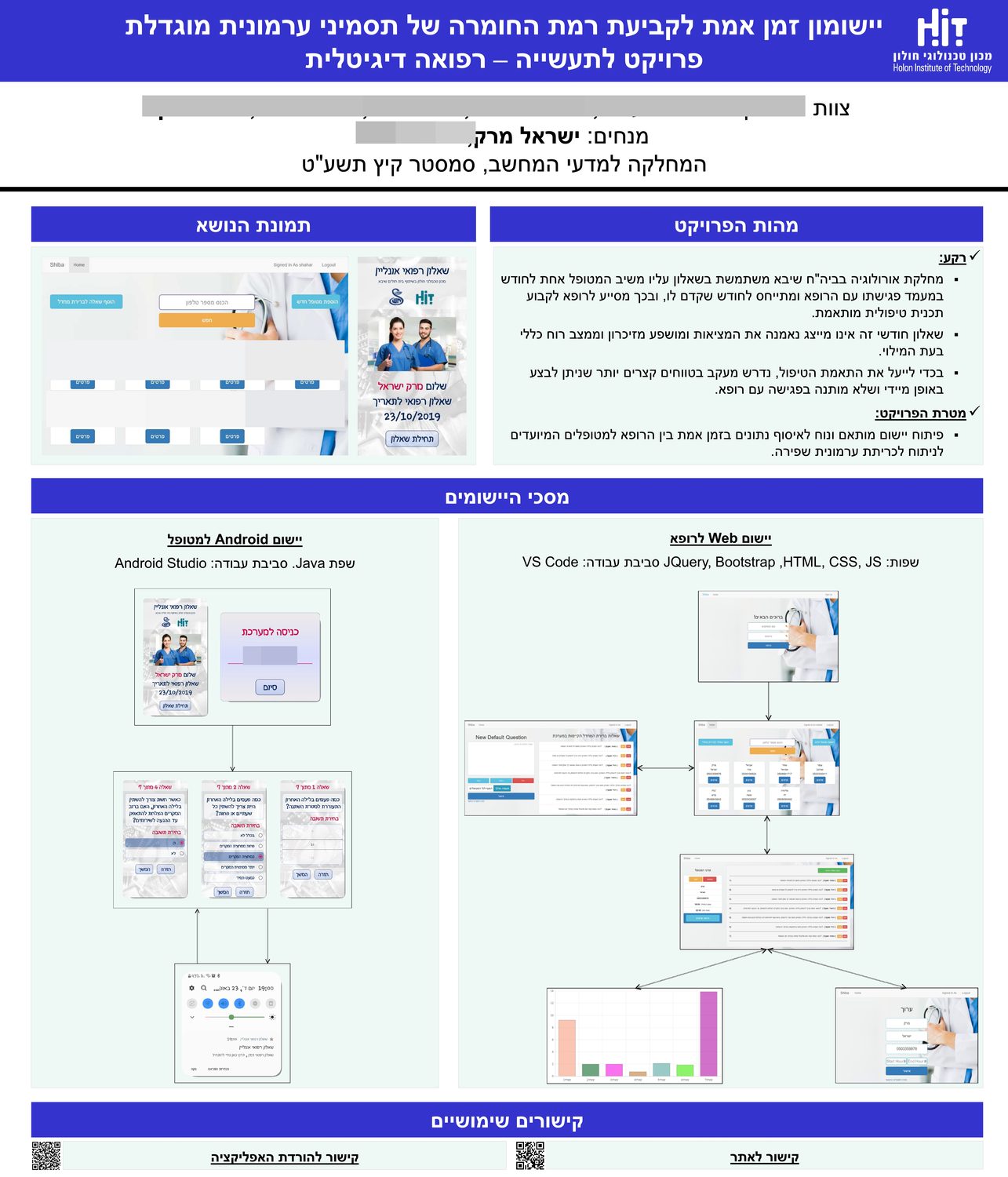
Real-time severity assessment for enlarged prostate symptoms
Digital medicine · Department of Computer Science · Summer 2019
A hospital urology department saw each patient about once a month, and between visits the physician had no signal at all about their condition. The team built a real-time medical questionnaire — an Android application for the patient and a web application for the physician — replacing recall at the next appointment with short-interval monitoring.
- Android
- Java
- JQuery
- Bootstrap
- HTML
- CSS
- JS
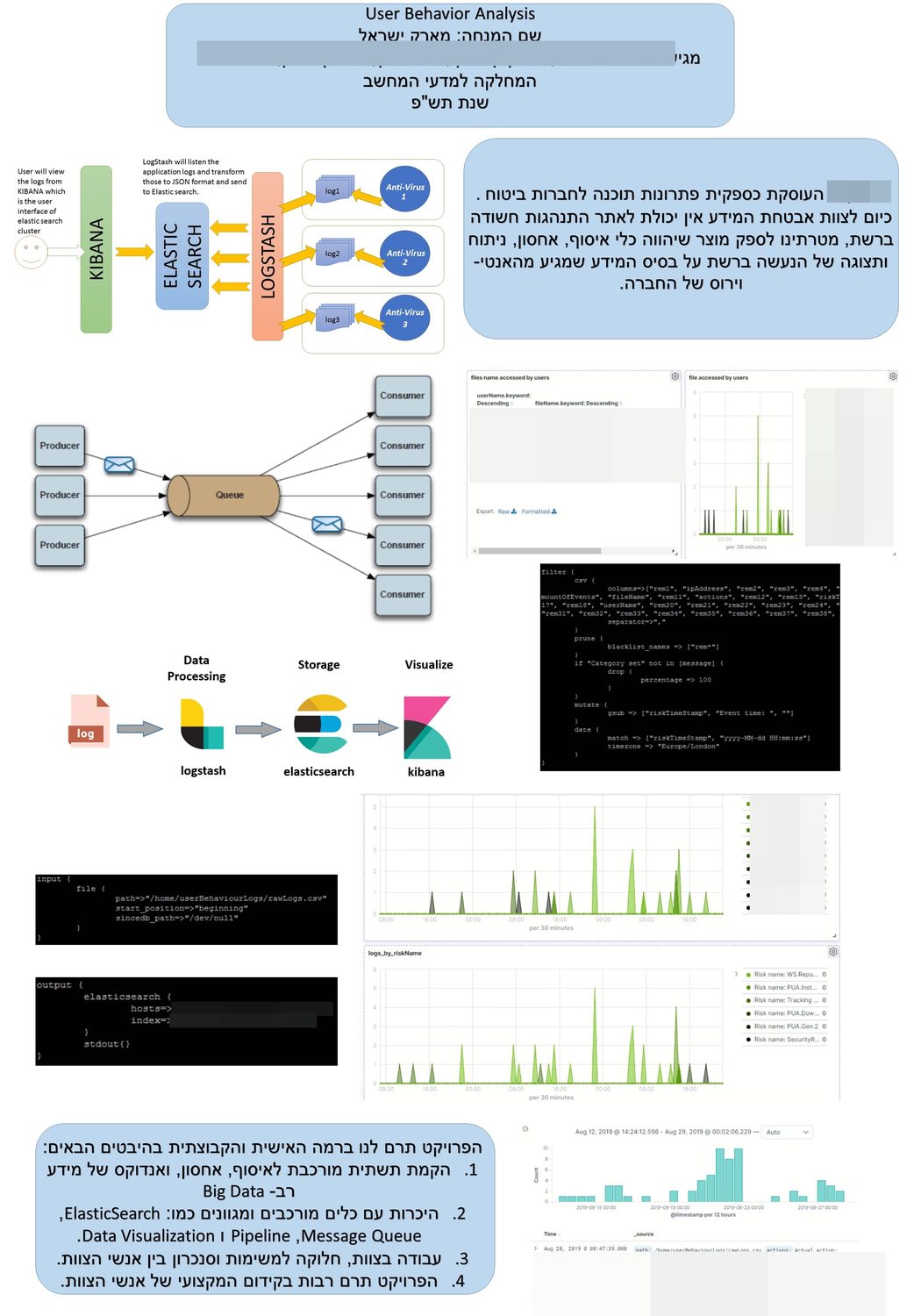
User Behavior Analysis
Department of Computer Science · 2020
The information security team at a software provider for insurance companies could not detect suspicious behaviour on its network. The team built a full Big Data pipeline — Logstash to collect, Elasticsearch to store and Kibana to analyse — running anomaly detection over the data arriving from the corporate anti-virus.
- Elasticsearch
- Logstash
- Kibana
- Big Data
- Message Queue
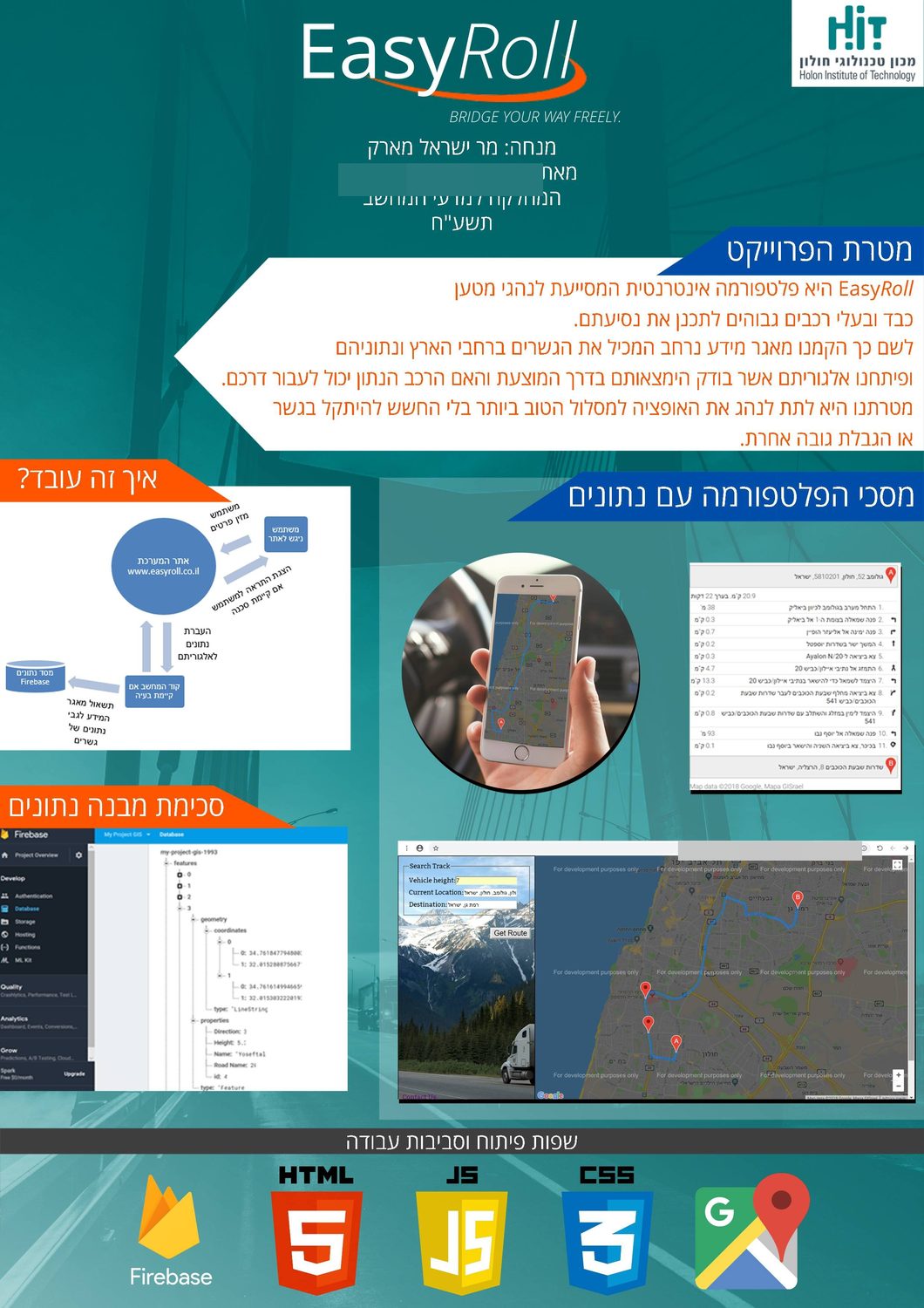
EasyRoll
Route planning for heavy and high vehicles · Department of Computer Science · 2018
A crane operator or a high truck meeting a low bridge finds out too late. The team built a platform that crosses a broad database of the country’s bridges with the vehicle’s own dimensions and returns a route the vehicle can actually take.
- Firebase
- HTML
- JS
- CSS
- Google Maps
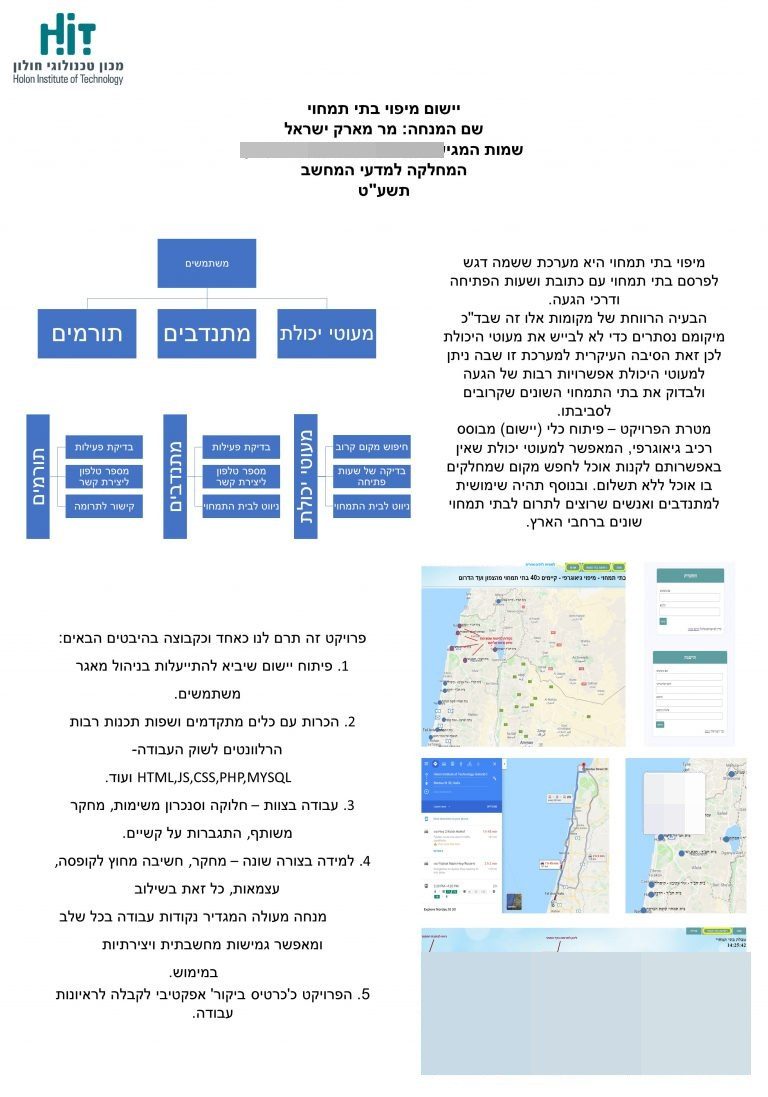
Soup kitchen mapping application
Social project · Department of Computer Science · 2019
Soup kitchens publish an address and opening hours, but the people who need them cannot always search openly. The team built a geographic application for finding a nearby free meal without exposure — and, in the same system, for connecting volunteers and donors to kitchens across the country.
- HTML
- JS
- CSS
- PHP
- MySQL
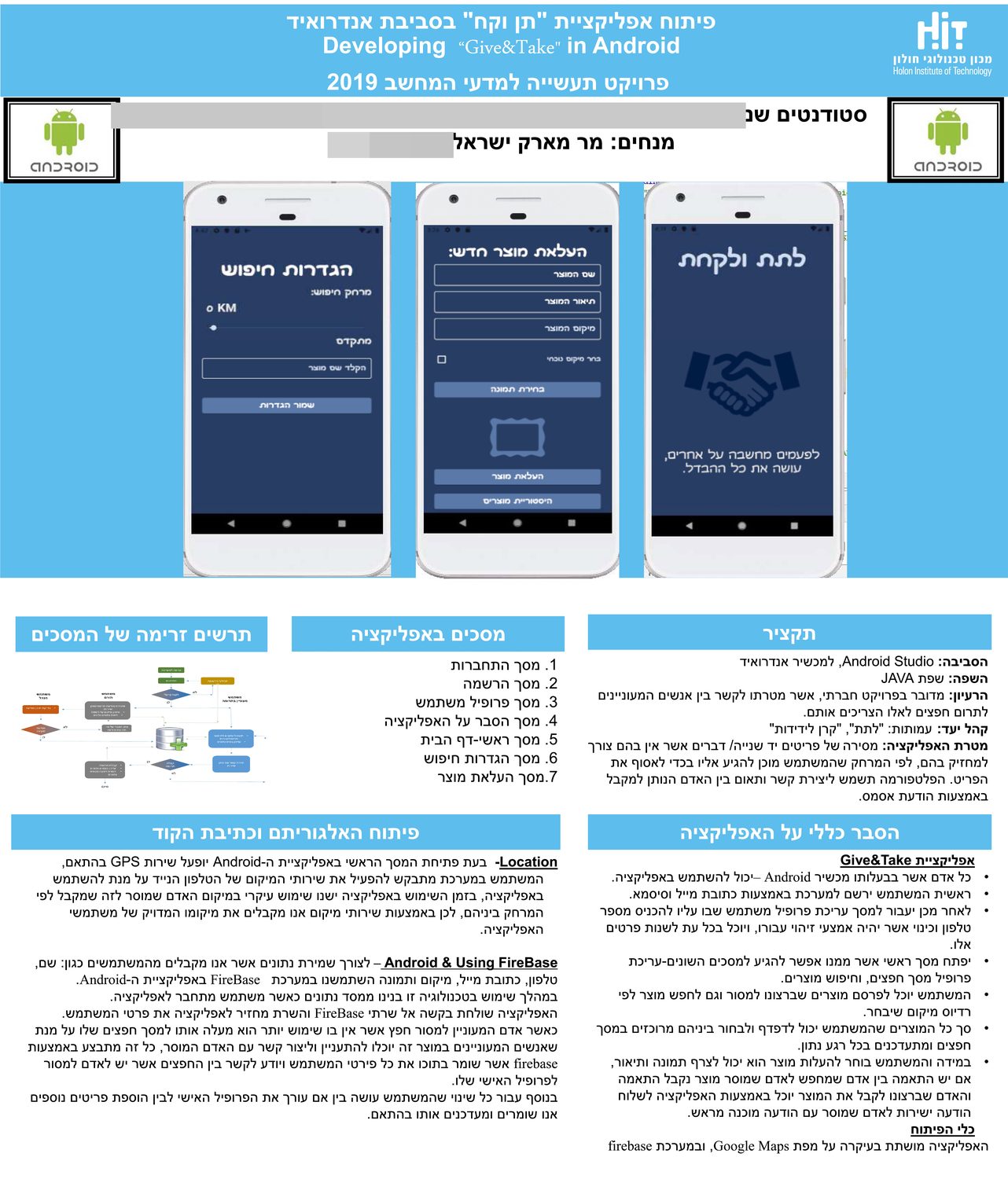
Give&Take
Social Android project · Department of Computer Science · 2019
What one person no longer needs is sometimes exactly what another lacks, and all that prevents the two from meeting is the absence of an easy way to make contact. The application lets people post an item for donation and find available items nearby, without exposing contact details until both sides choose to.
- Android
- Java
- Firebase
- Google Maps
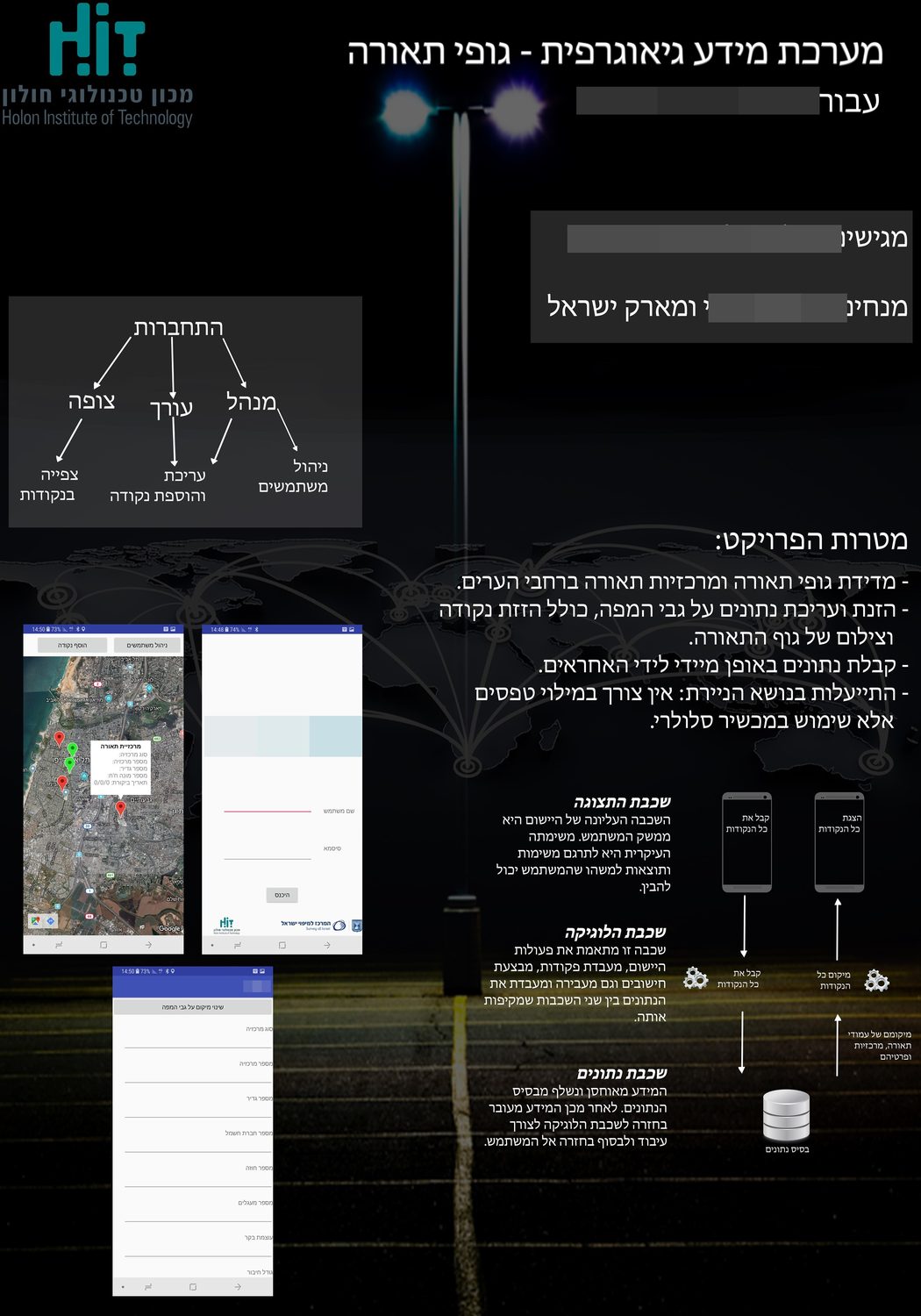
A geographic information system for street lighting
For an engineering company · Department of Computer Science · 2019
Surveying street lighting across a city was being done on paper forms. The team built a system in which the field worker enters and edits a point directly on the map from a mobile device — moving a point, photographing the fixture, with separate permissions for the manager, the editor and the viewer.
- Android
- GIS
- Google Maps
- User permissions
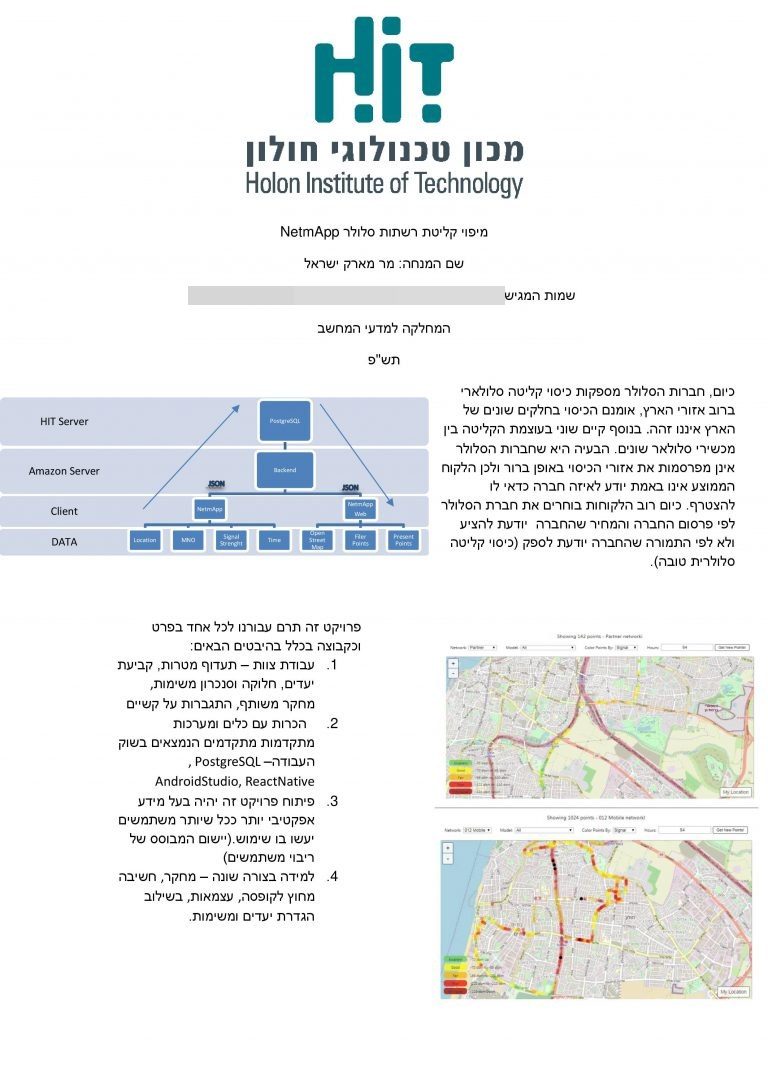
NetmApp
Mapping cellular reception · Department of Computer Science · 2020
Mobile operators publish coverage maps, but those maps do not let you compare operators at the same spot. The team built an application that gathers signal-strength measurements from the users themselves to produce a true picture of coverage — a multi-user system whose data improves the more it is used.
- PostgreSQL
- Android Studio
- React Native
- Amazon
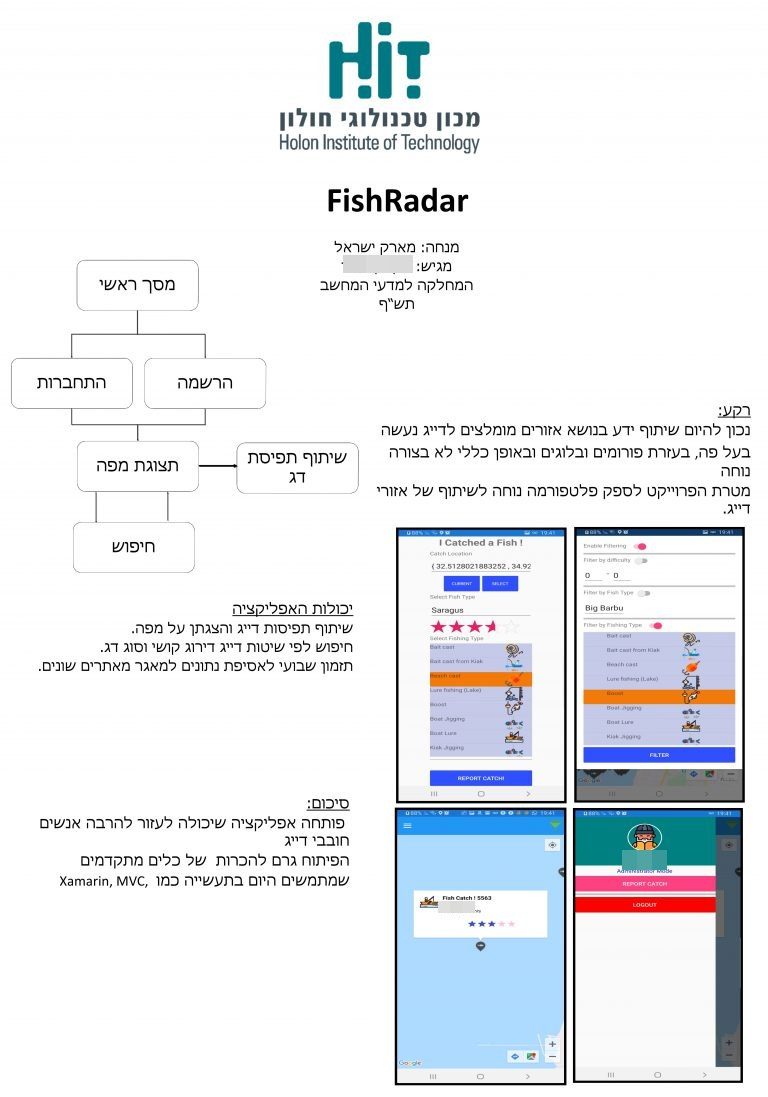
FishRadar
Knowledge sharing between anglers · Department of Computer Science · 2020
Knowledge about good fishing grounds passes by word of mouth and in forums, so it stays partial and hard to reach. The application records a catch on a map, filters by fishing method and species, and builds a shared store of knowledge that accumulates over time.
- Xamarin
- MVC
- GIS
- Android
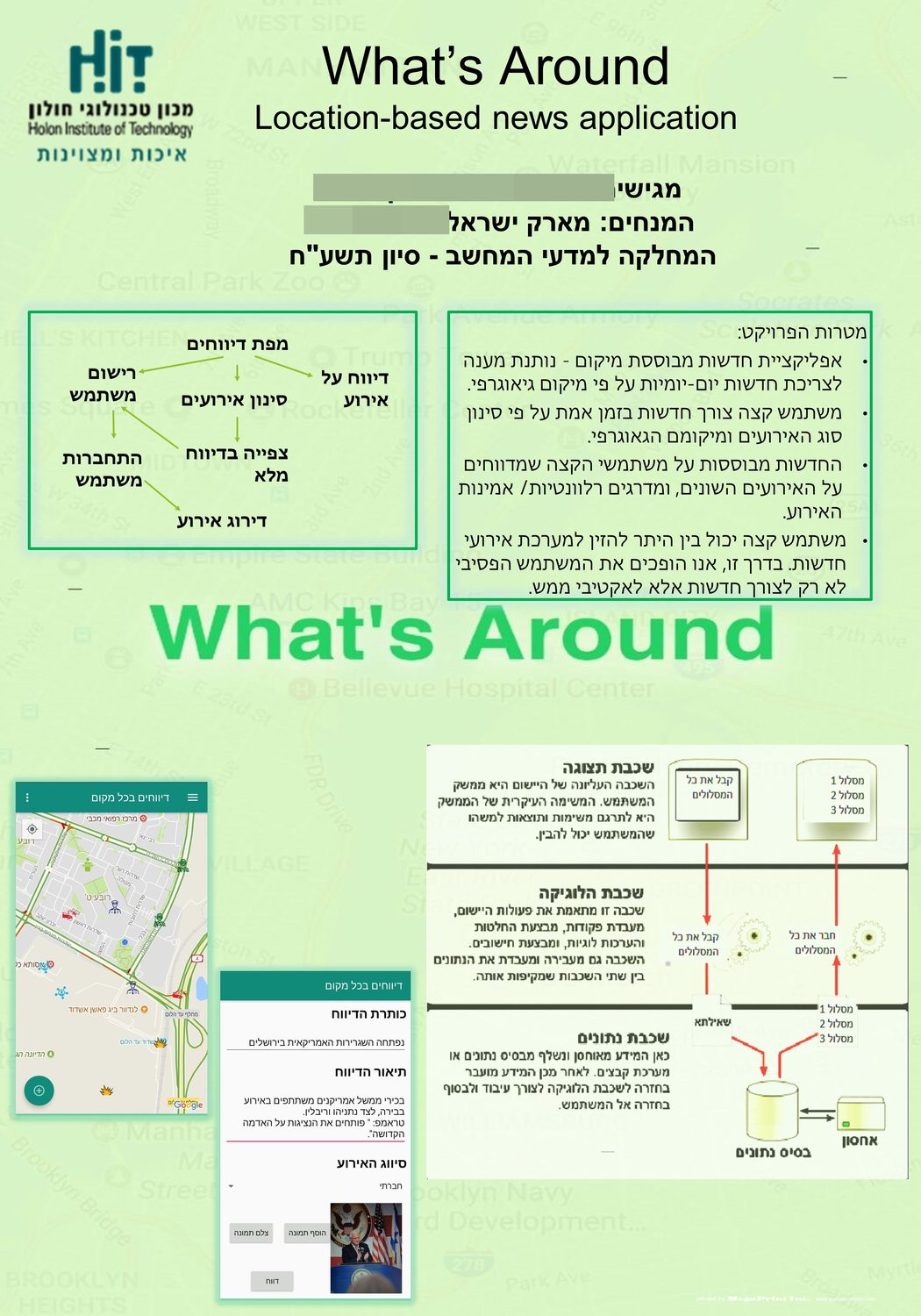
What's Around
Location-based news · Department of Computer Science · 2018
News arrives as one undifferentiated stream, whether the event is next door or very far away. The application turns the reader from a passive recipient into a reporter: anyone can report an event where they are, and reports are filtered by distance, event type and a reliability rating.
- Android
- GIS
- Layered architecture
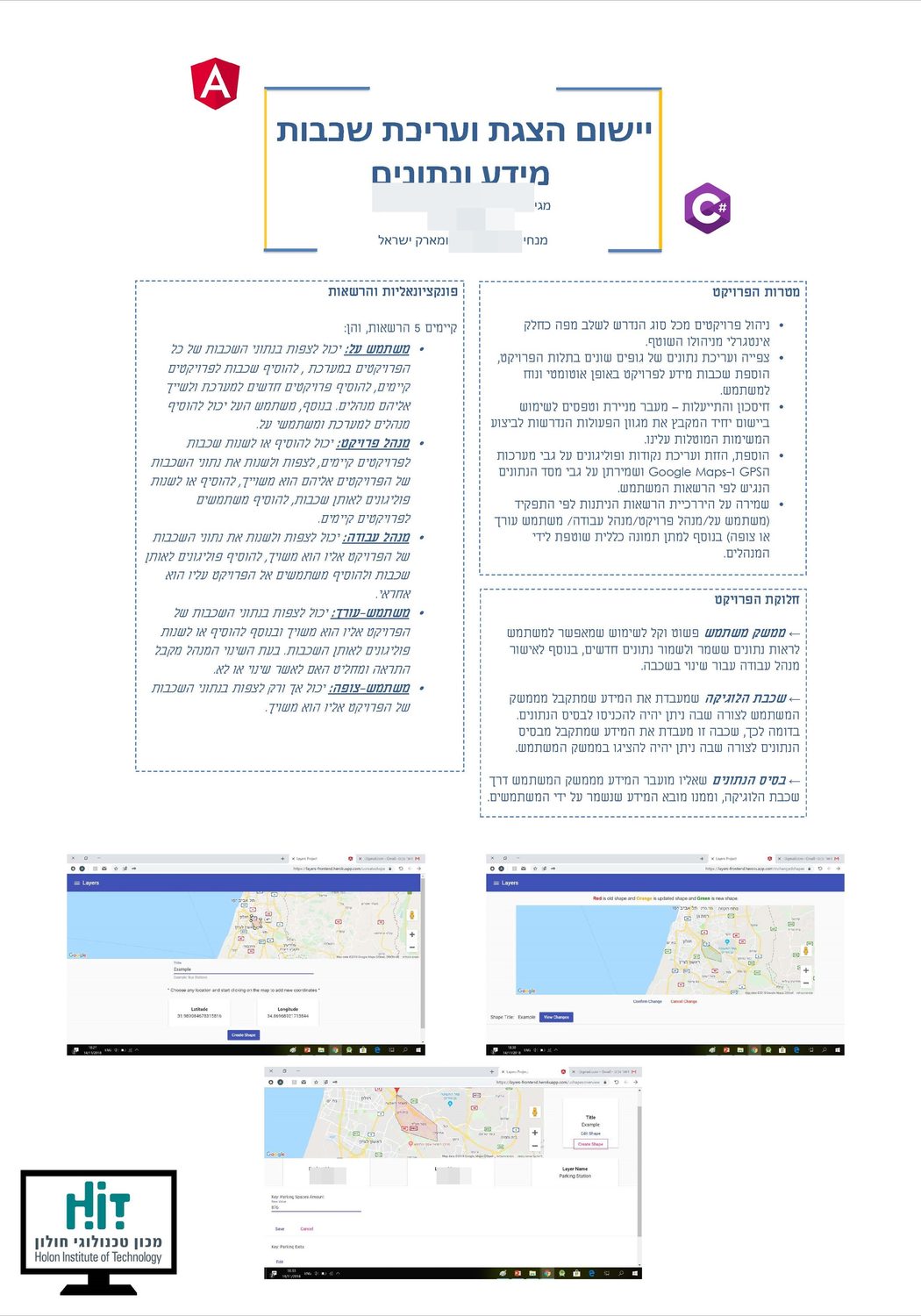
Displaying and editing information layers
A tool for managing geographic projects · Department of Computer Science
A management tool for geographic information layers: creating and editing polygons and points on a map, with five permission levels — from system administrator down to viewer — so each partner in a project sees and changes only what they should.
- Angular
- C#
- Google Maps
- GPS
The posters themselves are in Hebrew. Student names, the co-supervisor’s name, and every personal detail visible in the screenshots — mobile numbers, account names, file paths, an internal address — have been pixelated, as have the names of the client organisations, in keeping with the approach the rest of this site takes.
Timeline
Teaching roles
- 2016–2025
Lecturer and Head of the Projects Center, Faculty of Sciences
HIT — Holon Institute of Technology
Lectures in GIS, innovation, software development and project management; mentored hundreds of student projects; managed and trained ~20 mentors and domain coordinators.
- 2009–2010
Teaching Assistant
Ariel University Center of Samaria
Tutored faculty courses, emphasising accessibility of the material and student success.
- 2007–2016
Teaching Assistant, Faculty of Sciences
HIT — Holon Institute of Technology
Among the faculty’s most highly regarded TAs for knowledge, openness and willingness to help — per recommendations from senior lecturers.
Approach
How I teach
The foundation is an uncommon combination: mathematical depth from the first degree, current applied knowledge from the field, and the ability to join them so the student sees why the theory matters.
- A real project first. A short theoretical part sets a common foundation, and from there the work is on a problem somebody genuinely needs solved.
- Small multidisciplinary groups of up to five, guided jointly by a professional instructor and an industry representative.
- Transparent, well-defined success metrics set in advance — the student knows what their work is measured against.
- The output is a working prototype, documented to best practice so it can be folded into the partner company’s core product.
- Teaching in four languages lets me reach audiences across Central Asia and Eastern Europe in their own language, with no intermediary.
“The outputs of the students’ project-based training are enormous and have transformed the face of the Faculty of Exact Sciences.”
Happy to talk
Get in touch
Open to executive roles, academic collaborations, technology consulting and board positions.